


Uganda and Tanzania marked International Literacy Day 2026 through learner graduations, stronger Community Learning Centres, public dialogue and renewed commitments to Adult Learning and Education.
Across Uganda and Tanzania, the 2026 commemorations translated the theme “Literacy for People, the Planet and Prosperity” into action. Governments, learners, educators, communities, the media and development partners showed how literacy can strengthen livelihoods, participation and resilience when it is connected to relevant skills and accessible learning opportunities.
DVV International support from systems to communities
DVV International, carries out the international work of the Deutscher Volkshochschul-Verband e.V. (DVV), the German Adult Education Association, and supports sustainable Adult Learning and Education structures in more than 30 countries. In Tanzania, DVV International has worked since 2021 under a Memorandum of Understanding with the Ministry of Education, Science and Technology and the Prime Minister’s Office – Regional Administration and Local Government. Through the Adult Education System Strengthening in Tanzania project, it supports government efforts to improve the coordination, delivery and quality of Adult and Non-Formal Education (ANFE). In Uganda, DVV International’s engagement in Adult Learning and Education dates back to 1985, with a country office established in 2010. Working closely with the Ministry of Gender, Labour and Social Development and local government authorities, DVV International supports the development of an effective ALE system from community to national level, with particular emphasis on literacy, livelihood improvement and inclusive learning opportunities.
This support connects national systems with local implementation. At the macro level, DVV International contributes to policy, strategy, coordination, monitoring and professional frameworks. At the meso level, it strengthens institutions and the capacities of ANFE officials and practitioners. At the micro level, it works with Local Government Authorities, facilitators and communities to develop pilot Community Learning Centres (CLCs), improve learning spaces, provide equipment and link literacy with digital, vocational and livelihood skills. The 2026 literacy celebrations reflected this integrated approach in both Uganda and Tanzania.
Uganda celebrates learning achievement and stronger CLCs
Uganda opened its commemoration on 8 September with the release of the Uganda Literacy Magazine, which brought learner experiences, practitioner perspectives and policy messages into the public conversation.
https://drive.google.com/file/d/1elLk2geLO17nE0aZAJ6FWJMcPPArgm1f/view?usp=sharing
Rakai District
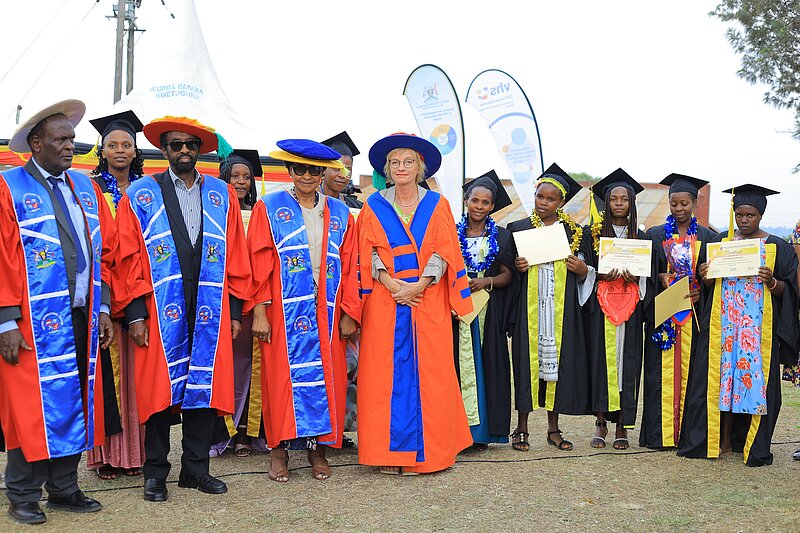
In Rakai, the Ministry of Gender, Labour and Social Development, Rakai District Local Government and Unbound convened government leaders, partners, communities and learners. The celebration, presided over by the Minister of State for Elderly Affairs, Hon. Jacklyn Mbabazi, included the graduation of 676 adult learners—541 women and 135 men—who had developed literacy, numeracy and livelihood skills through the Integrated Community Learning for Wealth Creation programme. The renovated Lwanda CLC was also commissioned, expanding access to community-based learning and skills development.
Nyakagyeme Regional Model CLC
On 10 September, Nyakagyeme Regional Model CLC in Rukungiri District graduated its first 28 vocational trainees: eight in Basic Computer Applications and 20 in Tailoring and Garment Cutting. The event was jointly organised by the Ministry, Rukungiri District Local Government and DVV International. Government leaders pledged further investment, including an additional training shelter and an irrigation system for the centre’s agricultural demonstration activities.
DVV International’s Regional Director for East/Horn of Africa handed over training materials and equipment valued at €10,000, including computers, tailoring equipment and hairdressing supplies. The support linked learning with the practical tools learners need to practise their skills, produce goods and pursue income-generating opportunities.
Tanzania connects national dialogue with local action
National level engagement and visibility
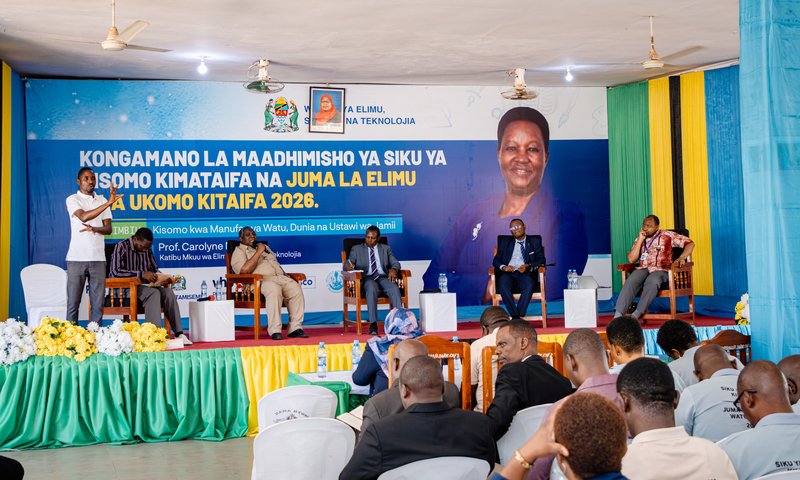
Tanzania’s commemoration was supported by early public engagement. On 7 September, the Institute of Adult Education and DVV International hosted a workshop in Dar es Salaam for 18 journalists from print, television, radio and digital media. Conducted with the Ministry of Education, Science and Technology and the Prime Minister’s Office – Regional Administration and Local Government, the workshop strengthened journalists’ understanding of ANFE, connected them with credible sources and encouraged reporting beyond ceremonial events.
A special 90-minute discussion on TBC1’s Mizani programme further broadened the conversation on second-chance education, community learning, skills pathways and the investment required to reach adults and out-of-school youth. View the TBC coverage.
The national commemoration followed in Bariadi, Simiyu Region, from 21 to 25 September. It combined a health walk, public exhibitions, technical sessions and a national symposium. Adult education officers from all 26 mainland regions and 184 councils reviewed implementation and agreed on priorities including stronger council financing, more MUKEJA classes, improved data use, expansion of the Literacy Assessment and Monitoring Programme (LAMP Scale), accessible CLCs and clearer stakeholder coordination.
DVV International contributed technical perspectives on LAMP Scale and shared experience from the pilot CLC in Kisarawe. It also supported national visibility through 700 branded T-shirts, a large stadium banner, an exhibition booth and publications. Visitors’ interest in the booth and the CLC approach demonstrated growing demand for information on community-based lifelong learning.
Regional level celebrations
On 17 September, the Dar es Salaam regional celebration at Mnazi Mmoja Grounds brought together ANFE stakeholders and District Adult Education Officers from across the city, with the Kinondoni District Commissioner serving as Guest of Honour. DVV International provided 50 T-shirts and caps to support visibility and participation.
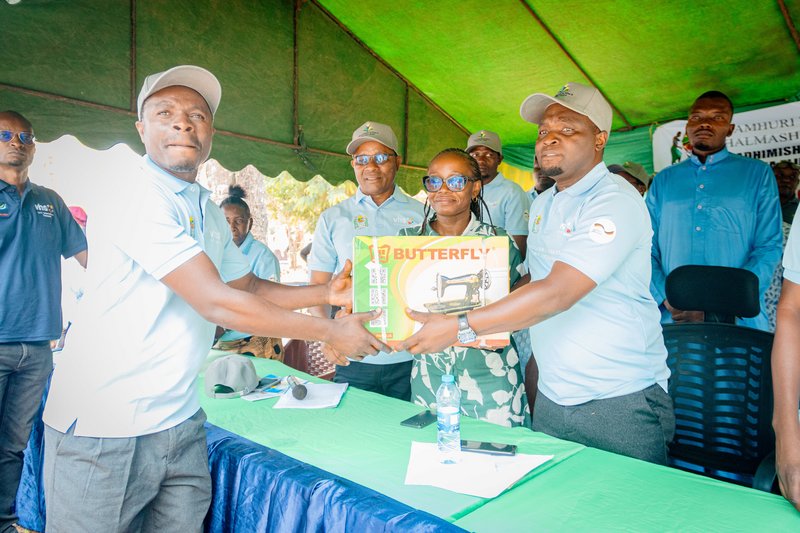
The Coast Region commemoration followed on 19 September at Ruvu JKT in Kibaha District Council. A total of 198 learners—101 women and 97 men—graduated. Regional and district leaders encouraged them to apply their skills for self-employment and to motivate others to learn. Kibaha District Council also handed over four sewing machines to the learners. Together with two machines previously donated by DVV International, the CLC now has six, demonstrating local government ownership building on partner support.
District and community level action
At the Kisarawe District celebration on 15 September, learners from Mzenga CLC presented the centre’s programmes, services and reach. The District Executive Director encouraged residents to use the centre and its equipment to create wider opportunities for the community. DVV International handed over five desktop computers and six sewing machines to strengthen digital and tailoring skills and provided 50 T-shirts and caps for the celebration.
From commemoration to implementation
The celebrations across Uganda and Tanzania confirmed that literacy has its greatest impact when it is connected to practical skills, functioning institutions and learning opportunities close to where people live. They also showed that CLCs can serve as an effective bridge between national policy and community priorities, while government leadership and local investment are essential for sustainability and scale.
The stronger media engagement in Tanzania helped extend the conversation beyond the events themselves. The next priority is to maintain that visibility while ensuring that resolutions lead to action. Agreed commitments should be assigned to responsible institutions and focal persons, supported by timelines and reviewed regularly. DVV International will continue working with government, communities and partners to strengthen inclusive learning systems and enable more young people and adults to turn literacy and skills into improved livelihoods and greater participation in society.